
La durabilité des produits est importante pour vous ?
Pour une alternative plus écologique à ce produit, ne cherchez pas plus loin.
DNeasy Blood & Tissue Kit (50) icon_0368_ls_gen_eco_friendly-s
N° de réf. / ID. 69504
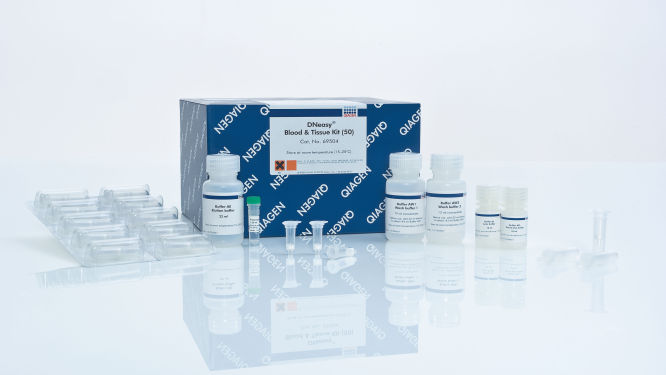
50 DNeasy Mini Spin Columns, protéinase K, tampons, Collection Tubes (2 ml)
KitFRNew
DNeasy Blood & Tissue Kit
DNeasy Blood & Tissue QIAcube Kit
Eco-friendlier kit
Type de colonneType de plaque
Mini
96-well
Préparations
50
250
Les DNeasy Blood & Tissue Kits sont destinés aux applications de biologie moléculaire. Ces produits ne sont pas conçus pour le diagnostic, la prévention ou le traitement des maladies.
La durabilité des produits est importante pour vous ?
Pour une alternative plus écologique à ce produit, ne cherchez pas plus loin.
Caractéristiques
- Une méthode standardisée pour divers types d’échantillons
- Des rendements élevés même à partir d’échantillons spécifiques
- ADN de haute qualité
- Des protocoles optimisés pour des matériels de départ très variés
- Formats de colonne de centrifugation et de 96 puits haut débit
- Flux de travail automatisés sur le QIAcube Connect
Détails produit
Les DNeasy Blood & Tissue Kits permettent une extraction rapide de l’ADN à l’aide d’un processus à base de silice, sans phénol ni chloroforme dans les formats de colonne de centrifugation et de plaque de 96 puits. Pour la plupart des échantillons, une lyse directe avec la protéinase K élimine le besoin d’une désagrégation mécanique, réduisant le temps de manipulation. Des protocoles sur mesure pour des échantillons spécifiques assurent une extraction constante d’ADN de haute qualité, idéal pour les sciences de la vie, le génotypage et la recherche d’agents pathogènes vétérinaires. Les kits peuvent être automatisés sur le QIAcube Connect.
Pour une alternative plus durable, le QIAwave DNA Blood & Tissue Kit réduit l’utilisation de plastique et de carton jusqu’à 62 % et 58 % respectivement. Des tubes de décharge réutilisables constitués à 100 % de plastique recyclé sont inclus dans le kit et peuvent être réutilisés pendant la procédure. Les tampons QIAwave sont concentrés, diminuant l’utilisation de plastique dans chaque flacon jusqu’à 90 %. Malgré les différences visuelles, le QIAwave Kit est tout aussi accessible que le kit standard, avec une chimie et des performances identiques. Remarque : Des flacons en verre stériles sont nécessaires pour la reconstitution de tampon.
En partenariat avec My Green Lab, nous avons évalué l’impact environnemental du DNeasy Blood & Tissue Kit (50/250) et du QIAwave DNA Blood & Tissue Kit (50/250). Les labels My Green Lab ACT du facteur d’impact environnemental visent à évaluer et noter les produits selon plusieurs critères de durabilité, parmi lesquels :
- La fabrication
- La gestion responsable des produits chimiques
- Le contenu durable dans les produits et les matériaux d’emballage
- L’élimination de l’emballage en fin de vie utile
Les produits sont notés de 1 à 10, à l’exception des produits de consommation d’eau et d’énergie à qui l’on attribue 1 point par kWh ou gallon, respectivement. Un score bas indique un impact faible (voir les figures « Labels du facteur d’impact environnemental ACT du DNeasy Blood & Tissue Kit et du QIAwave DNA Blood & Tissue Kit É.-U. [ 50/ 250], UE [ 50/ 250] et R.-U. [ 50/ 250]). ».


Performances
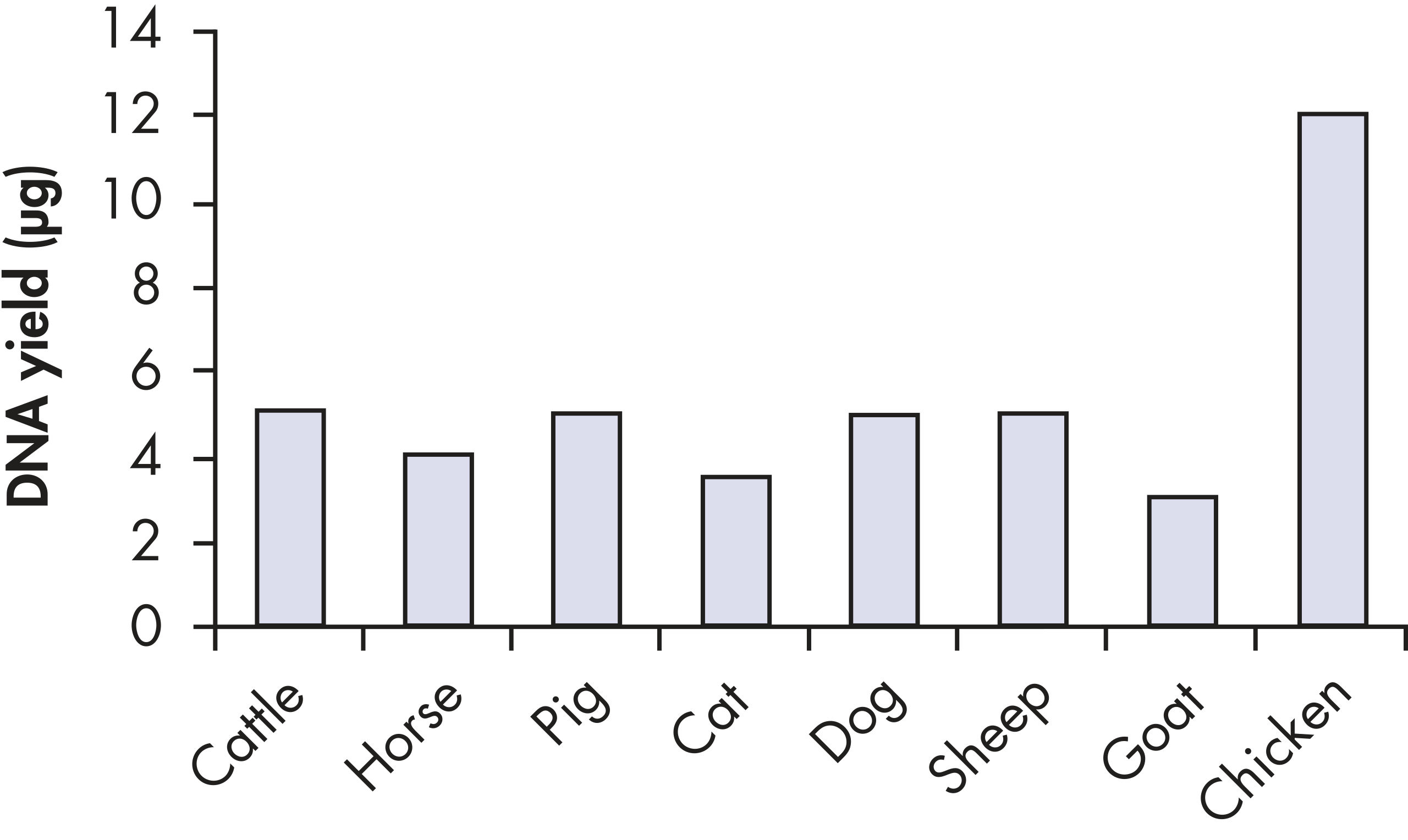
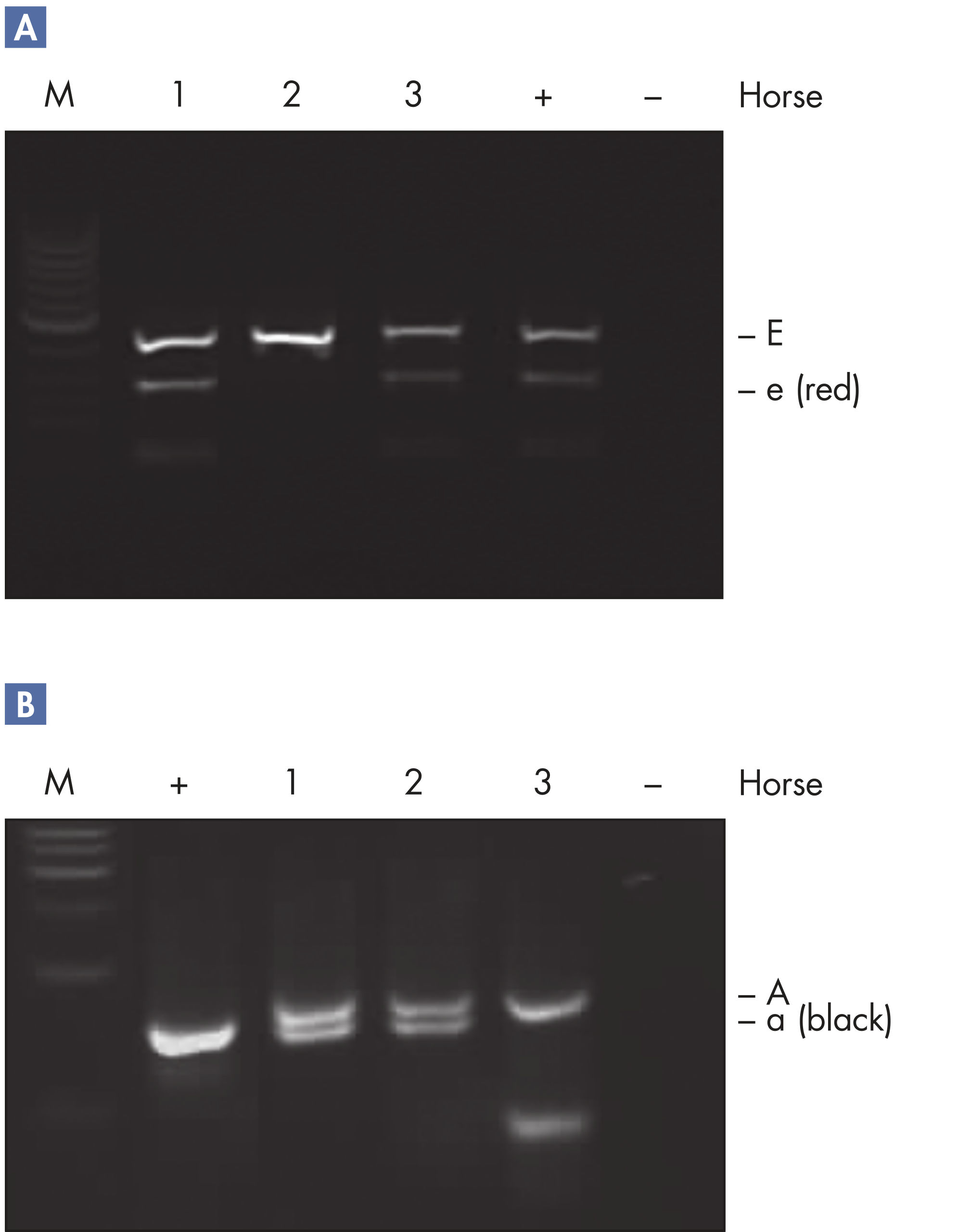
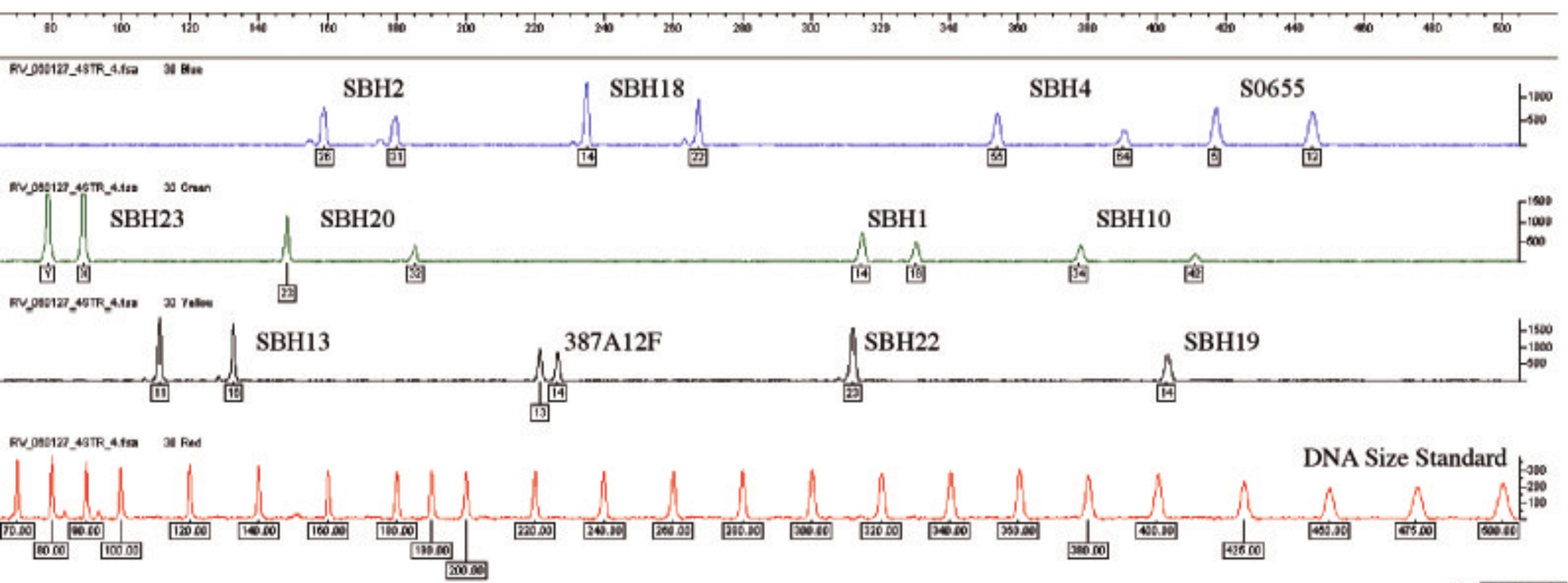
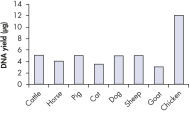
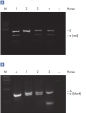
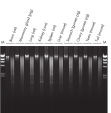
La procédure efficace des DNeasy et QIAwave DNA Blood & Tissue Kits permet de hauts rendements d’ADN total à partir d’échantillons sanguins et tissulaires animaux (voir le tableau Rendements typiques d’ADN à partir de tissus animaux et la figure Rendements d’ADN). Des protocoles optimisés assurent de hauts rendements à partir d’échantillons non standard, comme les poils d’animaux (voir Génotypage de chevaux), ainsi que les cellules de culture, les tissus fixés ou les bactéries à Gram positif ou négatif. Des protocoles spécialisés en ligne sont disponibles pour la purification de l’ADN à partir de levures, d’insectes, de poils ou d’autres types d’échantillons.
Puisque la chimie du QIAwave DNA Blood & Tissue Kit et des DNeasy Blood & Tissue Kits sont identiques, ils montrent les mêmes performances. Les deux kits ont montré des performances supérieures à celles des kits concurrents (voir la figure « Performances du QIAwave DNA Blood & Tissue Kit »).
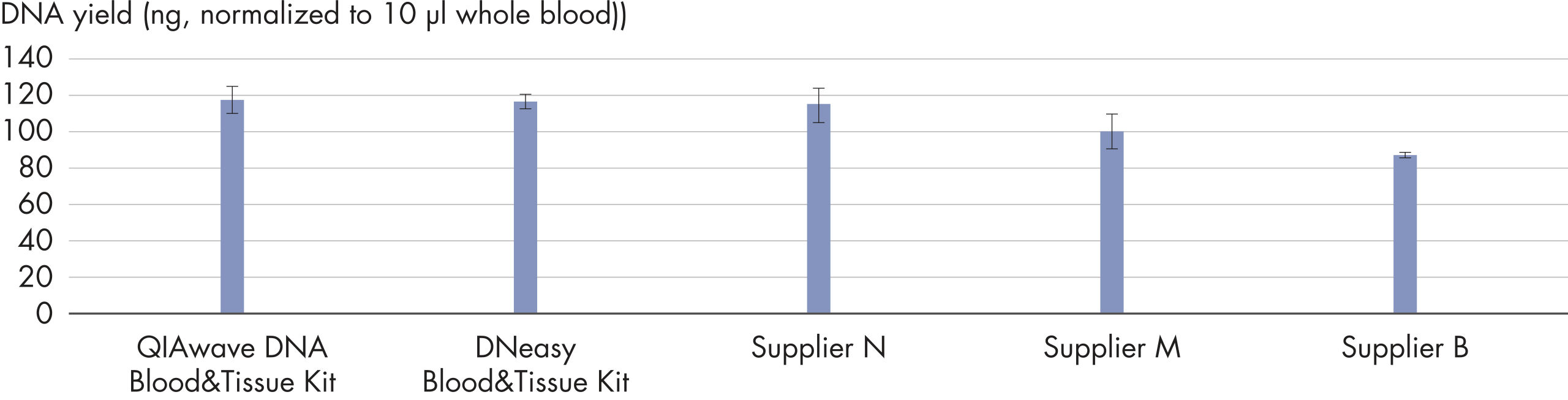
En suivant le protocole standard du QIAwave DNA Blood & Tissue Kit, de hauts rendements d’ADN total peuvent être isolés à partir d’échantillons sanguins et tissulaires animaux (voir le tableau « Rendements d’ADN typiques à partir de tissus animaux à l’aide du QIAwave DNA Blood & Tissue- » et la figure « Rendements d’ADN »). De plus, nous proposons des protocoles optimisés pour assurer de hauts rendements à partir d’échantillons non standard, tels que :
- Poils d’animaux
- Cellules de culture
- Bactéries à Gram positif et à Gram négatif
- Levures
- Insectes
- Autres types d’échantillons
| Source | Quantité | ADN (µg) |
| Sang de mammifère | 100 µl | 3 à 6 |
| Sang d’oiseau | 5 µl | 9 à 40 |
| Cellules HeLa | 2 x 10⁶ | 15 à 25 |
| Foie | 25 mg | 10 à 30 |
| Cerveau | 25 mg | 15 à 30 |
| Rein | 25 mg | 15 à 30 |
| Rate | 10 mg | 5 à 30 |
| Queue de souris | 1,2 cm (bout) | 10 à 25 |
| Queue de rat | 0,6 cm (bout) | 20 à 40 |
| Oreille de porc | 25 mg | 10 à 30 |
| Crin de cheval | 10 crins | 2 à 4 |
| Nageoire de poisson | 20 mg | 10 à 20 |
| Alevins (maquereau) | 10 mg | 5 à 10 |
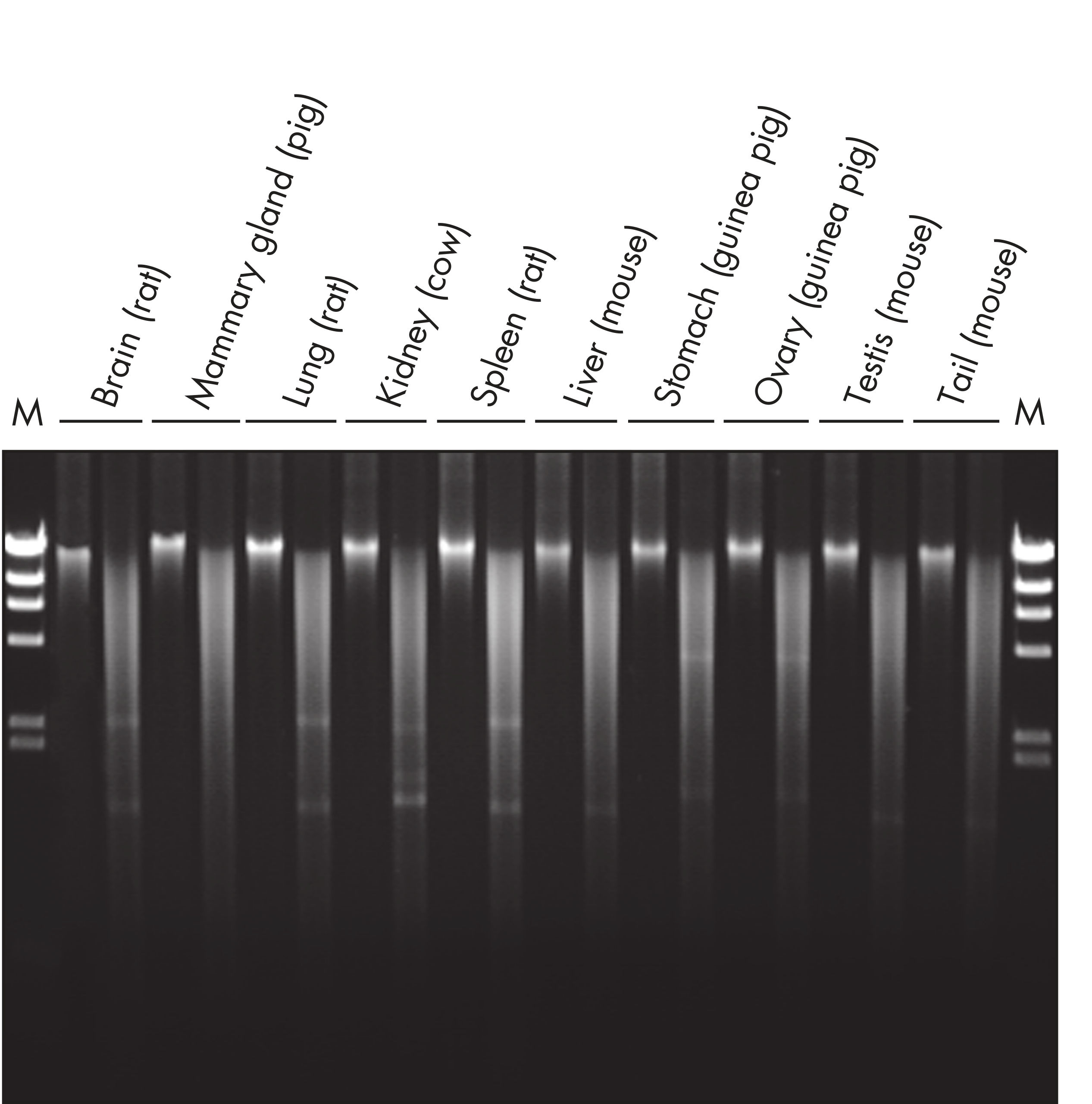
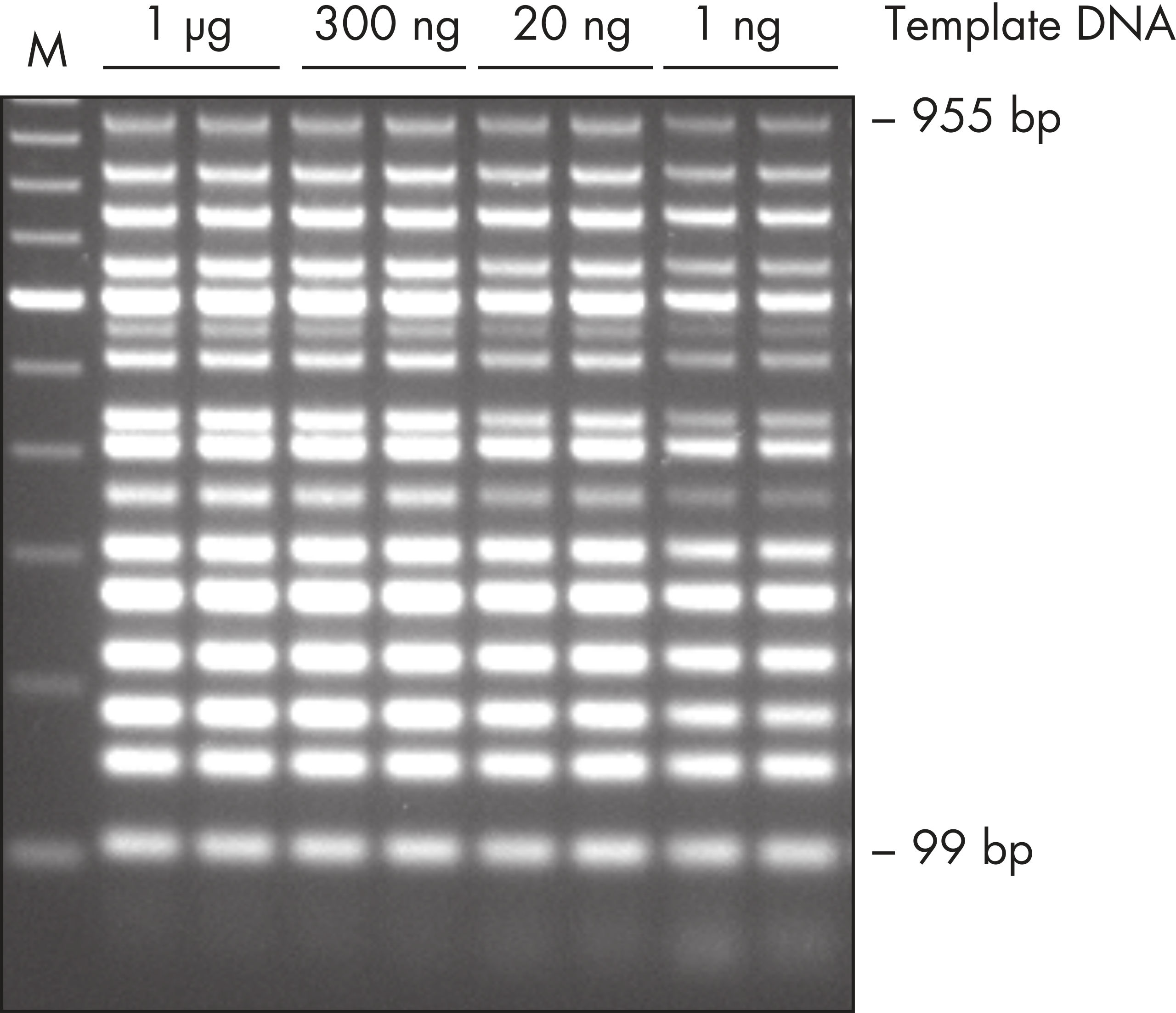
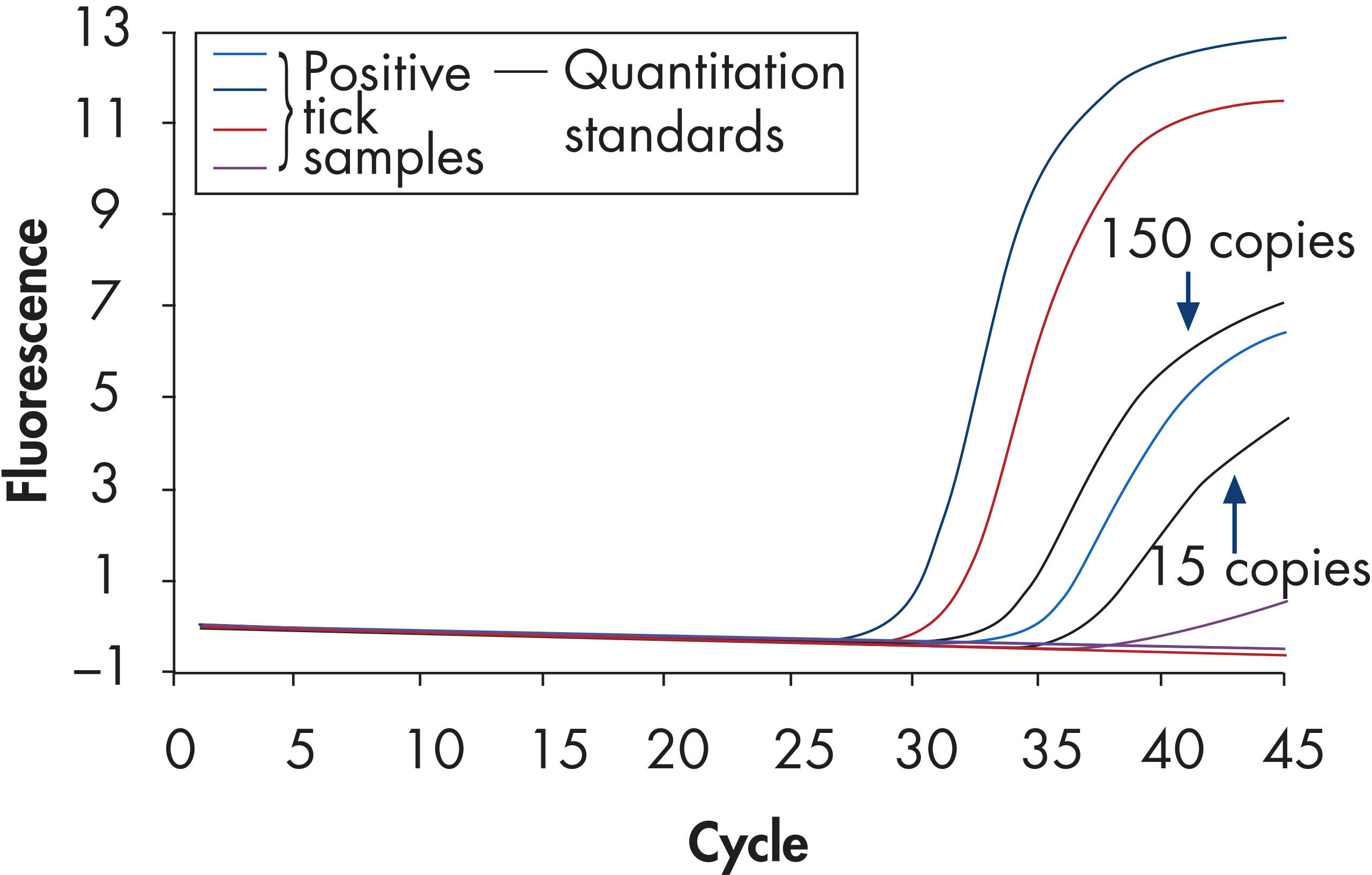
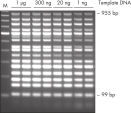
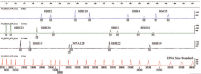
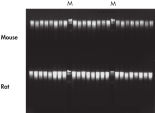
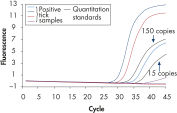
Les DNeasy Blood & Tissue Kits simplifient la purification d’ADN à partir d’une large gamme de types d’échantillons, y compris provenant d’espèces animales rencontrées fréquemment en sciences de la vie, en sciences vétérinaires et pour des applications de génotypage (voir « ADN de haute qualité »). L’ADN purifié est exempt d’inhibiteurs de PCR, ce qui permet une détection sensible en PCR standard, multiplex (voir PCR 16plex efficace) et real-time (voir real-time PCR). Les DNeasy Blood & Tissue Kits fournissent des résultats fiables, des analyses en laboratoire de souris transgéniques (voir Purification à haut débit) aux programmes d’élevage de bétail (voir Génotypage de porcs) ainsi que le génotypage de pédigrée. Les applications de tests de routine peuvent être facilement adaptées à l’aide du DNeasy 96 Blood & Tissue Kit (voir Purification à haut débit).
Principe
Les DNeasy et les QIAwave DNA Blood & Tissue Kits sont conçus pour la purification rapide de l’ADN total (p. ex. génomique, mitochondrial et pathogène) à partir de différentes sources d’échantillons, y compris les cellules et tissus animaux, le sang ou les bactéries, frais ou congelés.
La membrane DNeasy combine les propriétés de liaison d’une membrane à base de silice et la technologie simple d’une microcentrifugeuse ou du 96-Well-Plate Centrifugation System de QIAGEN. L’ADN est adsorbé par la membrane DNeasy en présence de hautes concentrations de sel chaotropique, qui élimine l’eau des molécules hydratées dans la solution. Les conditions du tampon des procédures DNeasy Blood & Tissue sont pensées pour permettre l’adsorption spécifique de l’ADN par la membrane de silice, en plus d’optimiser l’élimination des contaminants et inhibiteurs enzymatiques.
La purification ne requiert pas d’extraction ni au phénol ni au chloroforme ni aucune précipitation à l’alcool et demande une manipulation minime. Cela fait des DNeasy Blood & Tissue Kits une procédure particulièrement adaptée au traitement simultané de plusieurs échantillons. Pour des applications à plus haut débit, le DNeasy 96 Blood & Tissue Kit permet le traitement en simultané de 96 ou 192 échantillons.
Procédure
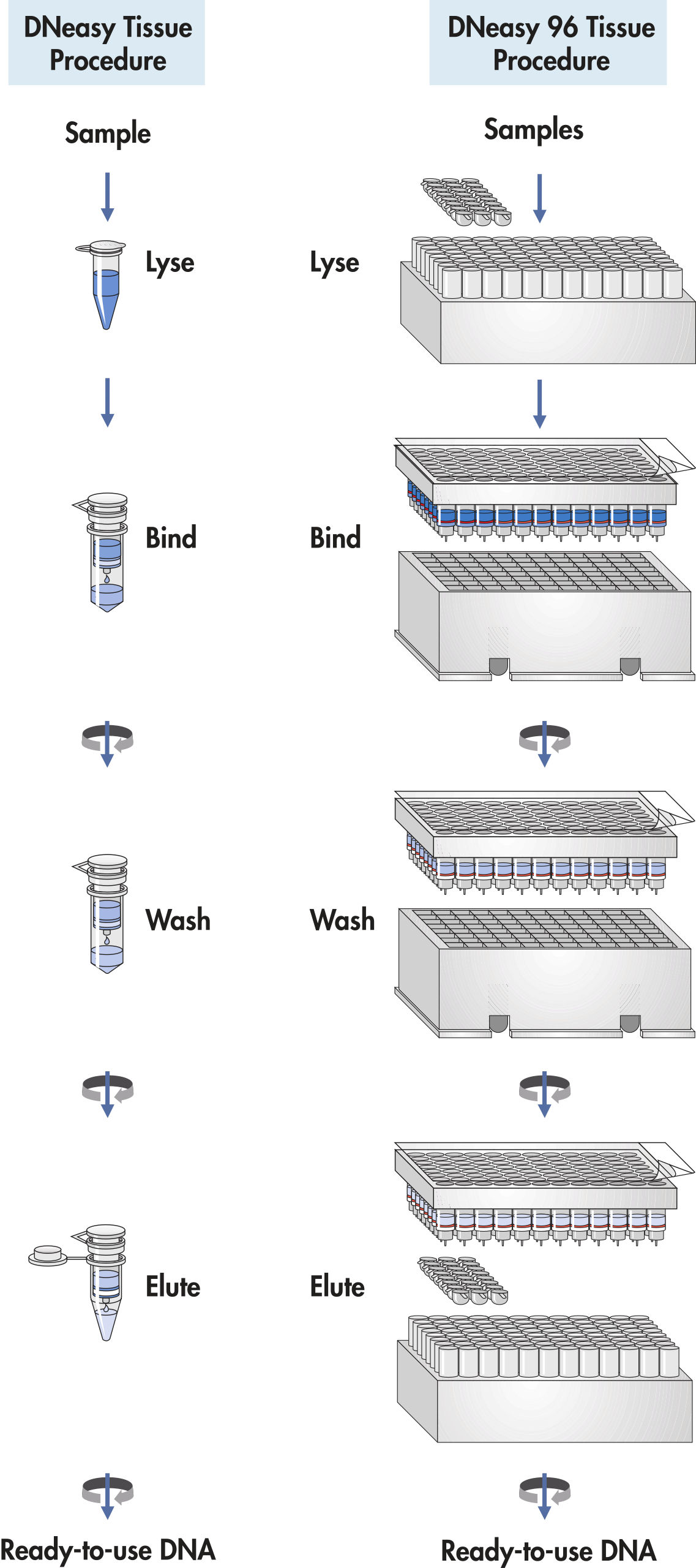
Une technologie fiable de membrane de silice, dans les formats pratiques de colonne de centrifugation ou de 96 puits, assure une purification de l’ADN rapide et reproductible, ce qui rend l’extraction organique et la précipitation à l’alcool inutiles (voir Procédures DNeasy Mini et 96). Tout d’abord, les échantillons sont lysés à la protéinase K. Les conditions de tamponnage sont ajustées pour offrir des conditions de liaison de l’ADN optimales, puis le lysat est chargé sur la colonne de centrifugation DNeasy Mini ou la plaque DNeasy 96. Lors de la centrifugation, l’ADN se lie de manière sélective sur la membrane DNeasy, tandis que les contaminants s’écoulent. Les contaminants et inhibiteurs enzymatiques restants sont éliminés par deux étapes de lavage efficaces, et l’ADN est enfin élué dans l’eau ou le tampon, prêt à être utilisé.
Les colonnes de centrifugation DNeasy Mini du DNeasy Blood & Tissue Kit sont préemballées dans des tubes de prélèvement et scellées individuellement, offrant confort et sécurité. La procédure de purification à l’aide des colonnes de centrifugation DNeasy Mini peut être automatisée sur le QIAcube Connect. Le DNeasy 96 Blood & Tissue Kit fournit un traitement haut débit dans un format de 96 puits grâce au 96-Well-Plate Centrifugation System de QIAGEN.
Les protocoles standard pour les DNeasy Blood & Tissue Kits peuvent être exécutés de manière homogène via le système TRACKMAN Connected.
Applications
Les DNeasy Blood & Tissue Kits et les QIAwave DNA Blood & Tissue Kits permettent d’obtenir un ADN de haute qualité prêt à l’emploi dans tous les dosages en aval, notamment les applications dPCR et NGS suivantes :
- Recherche dans le domaine des sciences de la vie
- Élevage de bétail
- Génotypage de pédigrée
- Recherche d’agents pathogènes vétérinaires
- Tests appliqués de routine
Données et illustrations utiles
Label du facteur d’impact environnemental ACT des DNA Blood & Tissue Kits (50), É.-U.
Les labels du facteur d’impact environnemental ACT sont destinés à évaluer et à noter les produits selon plusieurs critères de durabilité. Les produits sont notés de 1 à 10, à l’exception des produits de consommation d’eau et d’énergie à qui l’on attribue 1 point par kWh ou gallon, respectivement. Un score bas indique un impact environnemental faible. Le QIAwave DNA Blood & Tissue Kit (50) possède un EIF 21,5 % inférieur à celui du DNeasy Blood & Tissue Kit (50) aux États-Unis.


Spécifications
| Caractéristiques | Spécifications |
|---|---|
| ApplicationsFR | PCR, real-time PCR, génotypage |
| Elution volume | 100 à 200 µl |
| Time per run or per prep | 20 minutes à 1 heure |
| Main sample type | Sang, tissus |
| Format | Plaque de 96 puits, colonne de centrifugation |
| Sample amount | 100 µl/25 mg |
| Processing | Manuel |
| Yield | 6 µg/30 µg |
| Technology | Technologie à base de silice |
| Purification of total RNA, miRNA, poly A+ mRNA, DNA or protein | ADN |
Ressources
Scientific Posters (7)
Supplementary Protocols (4)
Quick-Start Protocols (3)
User-Developed Protocols (8)
Brochures & Guides (6)
Safety Data Sheets (5)
Kit Handbooks (4)
Certificates of Analysis (1)
Publications
The unique 16S rRNA genes of piezophiles reflect both phylogeny and adaptation.
Appl Environ Microbiol; 2006; 73 (3):838-45 2006 Dec 8 PMID:17158629
Assays to detect beta-tubulin codon 200 polymorphism in Trichuris trichiura and Ascaris lumbricoides.
PLoS Negl Trop Dis; 2009; 3 (3):e397 2009 Mar 24 PMID:19308251
Whole genome amplification for array comparative genomic hybridization using DNA extracted from formalin-fixed, paraffin-embedded histological sections.
J Mol Diagn; 2009; 11 (2):109-16 2009 Feb 5 PMID:19197000
Real-time PCR detection of pathogenic microorganisms in roof-harvested rainwater in Southeast Queensland, Australia.
Appl Environ Microbiol; 2008; 74 (17):5490-6 2008 Jul 11 PMID:18621865
MicroRNA-137 targets microphthalmia-associated transcription factor in melanoma cell lines.
Cancer Res; 2008; 68 (5):1362-8 2008 Mar 1 PMID:18316599
FAQ
How do I safely inactivate biohazardous flow-through material?
Do you have a protocol for purification of total DNA from yeast?
Do you have a protocol for purification of total DNA from insects?
Do you have a protocol for purification of total DNA from crude lysates?
Do you have data showing effects of sample size on DNA yield and purity using the DNeasy 96 Blood & Tissue kit?
What dedicated QIAcube Kits are available?
How can I precipitate genomic DNA using isopropanol?
303 - Can I use my own lysis buffer with the DNeasy Blood & Tissue or QIAamp DNA Mini Kit?
3192 - Is QIAGEN Protease compatible with Buffer ATL?
Is it possible to stop the DNeasy tissue protocol and store the tissue lysates after digesting in buffer ATL and Proteinase K?
What is the shelf-life for QIAGEN Proteinase K (cat. no. 19131, 19133)?
Is the quality and size of DNA extracted with the DNeasy Blood & Tissue kit good enough to generate DNA-libraries for next generation sequencing?
Are there important considerations for plasma generation and urine handling?
What QIAGEN kit can I use to isolate DNA from food products to test for genetically modified organisms (GMOs)?
How can I improve DNA yields from very tough tissues using the DNeasy Blood & Tissue Kit or the QIAamp DNA Mini Kit?
What water should I use to prepare the buffer concentrates?
What is the new Waste Tube made of?
Does the reuse of the Waste Tubes increase the risk of cross-contamination?
I don’t have any glassware in the lab, is the QIAwave kit still a good option for me?
Are the QIAwave kits based on a different chemistry than the legacy kits?
Is there a way to compare the environmental impacts of the kit?
Can the QIAwave kits be recycled?
What is the expected yield of genomic DNA isolated from bacteria with the DNeasy Blood & Tissue or QIAamp DNA Mini Kit?
What can be used as an alternative to the A260 measurement for quantification of small amounts of RNA and DNA?
What is the composition of buffer AE?
Do you have a protocol for isolation of genomic DNA from insects?
Do you have a protocol for the isolation of genomic DNA from bone?
Do you have a protocol for the isolation of genomic DNA from sperm?
Do you have a protocol for Acetyl Cysteine (NALC) treatment of viscous samples?
Do you have a protocol for isolation of genomic DNA from saliva and mouthwash?
Do you have a protocol for the isolation of DNA from soft tissues using the TissueLyser?
Do you have a protocol for the isolation of viral DNA from stool?
Do you have a protocol for isolation of genomic DNA from saliva using the DNeasy Blood & Tissue Kit?
Do you have a protocol for purification of DNA from cultured animal cells using the DNeasy 96 Blood & Tissue Kit?