
Want to try this solution for the first time?
Get in touch with our specialists if you need a quote or if you would like to discuss your project.
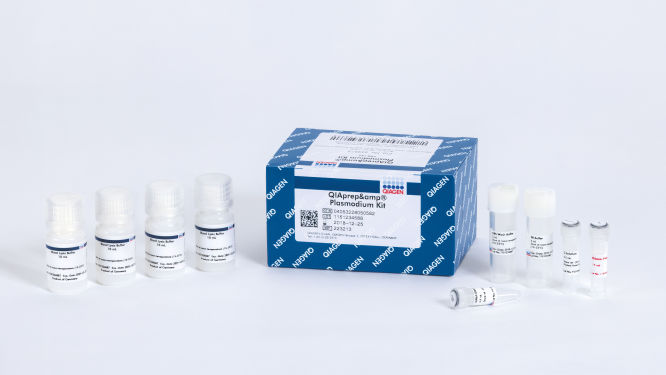
QIAprep& Plasmodium Kit
Cat no. / ID. 223213
QIAprep& Plasmodium Kit is a qPCR master mix for direct detection of Plasmodium in liquid blood samples or in dried blood spot samples at a sensitivity of 1parasite/µL; for 100 reactions
The QIAprep& Plasmodium Kit is intended for molecular biology applications. This product is neither intended for the diagnosis, prevention or treatment of a disease, nor has it been validated for such use either alone or in combination with other products.
Want to try this solution for the first time?
Get in touch with our specialists if you need a quote or if you would like to discuss your project.
Features
- Detects Plasmodium DNA directly from dried blood spots or whole blood, saving time and reagent costs
- Multiplex qPCR assays enable species differentiation (P. falciparum, P. vivax, P. malariae, P. ovale and P. knowlesi)
- High sensitivity, detecting as low as 1 parasite/µL
- Compatible with most real-time qPCR instruments
Product Details
The QIAprep& Plasmodium Kit streamlines Plasmodium detection by using direct qPCR. Researchers can analyze dried blood spots or whole blood directly, reducing hands-on time and reagent costs. The kit enables a high sensitivity of plasmodium detection at 1 parasite/µL, which is crucial for malaria surveillance and epidemiological research.
Together with the QIAprep& Plasmodium assays, the differentiation of Plasmodium species (P. falciparum vs. non-falciparum to detection of P. vivax, P. malariae, P. ovale and P. knowlesi) takes place in one reaction in multiplex format.
Would you like to learn more about the product from one of our specialists? Contact us, and we’ll get in touch with you shortly.
Performance
The QIAprep& Plasmodium Kit enables rapid qPCR analysis with results in 1–1.5 hours. It provides sensitivity comparable to or better than traditional DNA extraction-based methods, detecting down to 1 parasite/µL. The workflow is robust across different sample types and works with common real-time qPCR systems.
| Hit Rate QIAprep& | Hit Rate classical DNA extraction followed by PCR | |||||||||
| Bloodstain card | Classic card | |||||||||
| Samples | Dilution | Parasites per µL | Liquid direct WF | Liquid sedimentation WF | DBS direct | DBS elution | DBS direct | DBS elution | Liquid | DBS |
| P. falciparum culture | 1:100 | 79.4 | 100% | 100% | 100% | 100% | 100% | 100% | 100% | 100% |
| 1:1000 | 7.9 | 100% | 100% | 100% | 100% | 100% | 100% | 100% | 100% | |
| 1:10,000 | 0.8 | 75% | 100% | 100% | 100% | 50% | 100% | 100% | 50% | |
|---|---|---|---|---|---|---|---|---|---|---|
| 1:100,000 | 0.08 | 0% | 88% | 0% | 88% | 0% | 75% | 100% | 25% | |
| Sample A | 1:100 | 163.2 | 100% | 100% | 100% | 100% | 100% | 100% | 100% | 100% |
| 1:1000 | 16.3 | 100% | 100% | 100% | 100% | 100% | 100% | 100% | 100% | |
| 1:10,000 | 1.6 | 88% | 100% | 100% | 100% | 83% | 100% | 100% | 100% | |
| 1:100,000 | 0.16 | 50% | 100% | 33% | 88% | 50% | 88% | 100% | 25% | |
| Sample B | 1:100 | 159.9 | 100% | 100% | 100% | 100% | 100% | 100% | 100% | 100% |
| 1:1000 | 16.0 | 100% | 100% | 100% | 100% | 100% | 100% | 100% | 100% | |
| 1:10,000 | 1.6 | 100% | 100% | 100% | 100% | 100% | 88% | 100% | 75% | |
| 1:100,000 | 0.16 | 0% | 100% | 50% | 75% | 33% | 38% | 100% | 0% | |
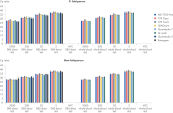
P. falciparum culture and two human samples (Samples A and B) were diluted with Plasmodium-negative blood. DNA was extracted using the QIAamp® DNA Blood Mini Kit, and parasitemia was quantified via digital PCR with the QIAcuity® Probe PCR Kit on a QIAcuity Four Platform. For dried blood spot (DBS) workflows, 75 μL of diluted samples were applied to QIAcard Bloodstain or Classic card and dried for 24 h. Four workflows (Whole blood, sedmination, DBS direct and DBS elute) followed handbook protocols using the Pf/Non-Pf Detection Assay assay. Hit rates (DBS direct N=6; classical DNA workflows N=4; all others N=8) were recorded, with all samples run on Bio-Rad® CFX96™ or CFX384 instruments. (WF = workflow)
Principle
This kit integrates direct sample processing with qPCR to detect Plasmodium spp. For whole blood, a brief heat treatment releases nucleic acids. Dried blood spots can be used directly in the reaction or undergo minimal processing to recover eluate for use in several qPCR reactions with higher sensitivity. This kit is suitable for assays that detect Plasmodium DNA with high specificity and distinguish between P. falciparum and non-falciparum species. A second assay enables further species differentiation (P. vivax, P. malariae, P. ovale, and P. knowlesi). The two assays are available separately and can be used alone or in combination.
Procedure
The QIAprep& Plasmodium Kit is suitable for whole blood samples and dried blood spots (DBS) as starting material. Two workflows are available for each sample type: ultrafast and ultrasensitive.
Table 1. Selecting the right workflow according to your sample type and process requirements
| Sample | Faster results in fewer steps | More sensitive results |
|---|---|---|
| Dried Blood Spots (DBS) | DBS direct workflow | DBS elution workflow |
| Whole blood | Whole blood workflow | Sedimentation workflow |
Sample preparation
The new QIAprep& Plasmodium Kit is designed for use with whole blood samples (for example, EDTA, citrate, heparin) and dried blood spots. Suitable sample types include:
- Fresh whole blood
- Frozen whole blood
- Dried blood spots from whole blood
- Dried blood spots from finger-prick blood
The QIAprep& Plasmodium Kit technology allows the use of 20% of blood in the PCR reaction.
Two workflows per sample type (whole blood or DBS) are provided. One workflow provides ultrafast results with few steps. An alternative workflow provides superior sensitivity with fewer handling steps (see Table 1).
qPCR setup
Combine the QIAprep& mastermix with the sample and assay mix. Load the reaction onto a PCR plate or vial and put it on a cycler. For more information, check the Quick Start Protocol or Product Handbook.
Cycling and detection
Run the real-time qPCR. Once the run is complete, analyze the results using the appropriate cycler software.
For the generation of dried blood spots, we recommend the following:
- The QIAcard Bloodstain card (cat. no. WB100014) or the QIAcard FTA Classic card (cat. no. WB 120205 or WB120305) or Whatman filter cards
- Puncher, such as, UniCore Punch 1.2 mm for DBS direct WF (cat. no. WB100074), 3 mm for DBS Elution WF (cat. no. WB100078) or comparable punchers
- Cutting mat (cat. no. WB100088)
Applications
- Malaria surveillance and epidemiological studies
- Plasmodium detection in research labs
- Plasmodium speciation in research labs
- Field studies requiring fast, sensitive, extraction-free qPCR
Supporting data and figures
High specificity and sensitivity of the QIAprep& Plasmodium Kit
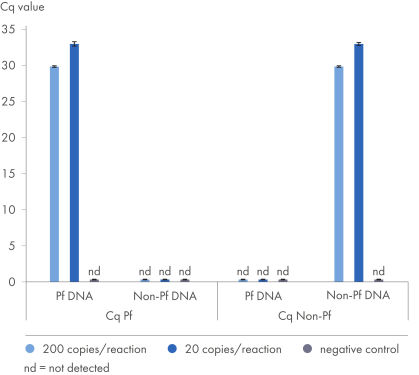
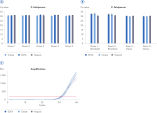
Two artificial DNAs containing sequences for the targeted regions of the Pf/Non-Pf Detection Assay have been applied to rapid whole blood workflow to compare the sensitivity for both targets. The concentration of the artificial DNA was determined by digital PCR using the QIAcuity® Probe PCR Kit on a QIAcuity Four Platform System. All samples (n=4 for 200 copies/reaction, n=8 for 20 copies/reaction and negative control) were run on the Bio-Rad® CFX96™ instrument. Similar Cq values indicate the same sensitivity of both targets. As expected, no amplification could be observed with the negative controls and on the nonmatching DNAs.

Resources
Certificates of Analysis (1)