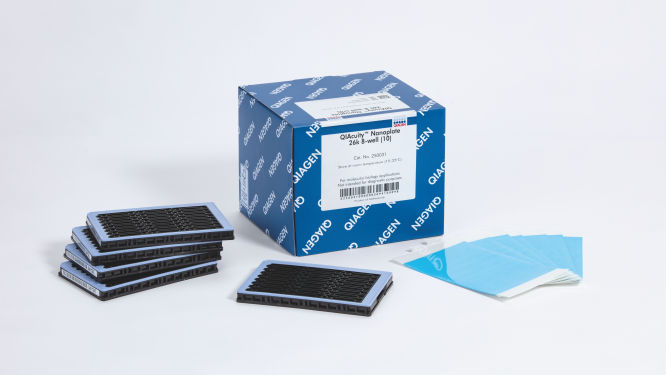
QIAcuity Nanoplatesおよびアクセサリー

QIAcuityデジタルPCR装置で使用

S_1220_3_LS_dPCR_Nanoplate_26k_8well

✓ オンライン注文による24時間年中無休の自動処理システム

✓ 知識豊富で専門的な製品&テクニカルサポート

✓ 迅速で信頼性の高い(再)注文

QIAcuity Nanoplate 26k 8-well (10)

カタログ番号 / ID.   250031

10 QIAcuity Nanoplate 26k 8-well, 11 Nanoplate Seals
Product TypeAccessories
QIAcuity Nanoplate
Nanoplate Seals
Nanoplate Tray
Nanoplate Adapter
ウェルあたりのパーティション
26k
8.5k
ウェル数
8
24
QIAcuity Nanoplatesおよびアクセサリーは分子生物学的アプリケーション用であり、疾病の診断、予防、あるいは治療に使用することはできません。

✓ オンライン注文による24時間年中無休の自動処理システム

✓ 知識豊富で専門的な製品&テクニカルサポート

✓ 迅速で信頼性の高い(再)注文

特徴

  • さまざまなアプリケーションのニーズに対応した4種類のナノプレート
  • 1ウェルあたり8500分画または26,000分画
  • SBS規格に準拠

製品詳細

QIAcuity NanoplatesはデジタルPCR用のマイクロ流体プレートです。1ウェルあたりの分画数は8,500または26,000で最大8サンプル、24サンプルまたは96サンプルを処理できます。4種類のナノプレートはすべて、QIAcuity Digital PCR Systemでの使用を想定して設計されています。

これらのナノプレートは、QIAcuity Digital PCR Systemでのみ使用できます。QIAgilityを使用してQIAcuity Nanoplatesにおける液体の取り扱いとPCRセットアップを自動化するには、専用のQIAcuity Nanoplate Adapterをご使用ください。アダプターを取り付け後、QIAcuity Digital PCR SystemにプレートをロードしてdPCRを実施します。

製品について詳しくお知りになりたい場合は、弊社のdPCRスペシャリストより連絡を差し上げますので、こちらからサインインしてください。

パフォーマンス

QIAcuity装置によるデジタルPCR用に特別に設計されたプレートです。アプリケーションの用途に応じた仕様を満たし、SBS規格に準拠した4種類のナノプレートを提供しています。


Nanoplates – 機能と仕様
タイプ フレームカラー 仕様 アプリケーション
Nanoplate 26K 8-well ライトブルー

8ウェル、約26,000分画 

1ウェルあたり容量 40 µl

希少突然変異検出、 
リキッドバイオプシー、遺伝子 
発現解析、 
病原体検出等 
Nanoplate 26K 24-well ブルー

24ウェル、約26,000分画

1ウェルあたり容量 40 µl

希少突然変異検出、
リキッドバイオプシー、遺伝子
発現解析、
病原体検出 等
Nanoplate 8.5K 24-well ホワイト

24ウェル、約8,500分画

1ウェルあたり容量 12 µl

コピー数多型解析、
遺伝子発現解析、
NGSライブラリー定量、
ゲノム編集
検出等
Nanoplate 8.5K 96-well グレー

96ウェル、約8,500分画

1ウェルあたり容量 12 µl

原理

分注およびロード、実験、結果解析というわずか3つのステップで、2時間以内にdPCRの結果が得られます。ナノプレートでのdPCRの原理はこちらで説明しています。

操作手順

qPCR実験と同様に、サンプル調製では、マスターミックス、プローブ、プライマーを8、24または96ウェルナノプレートに加え、その後サンプルを加えます。このシステムは、パーティショニング、サーマルサイクル、イメージングを1つに統合した完全自動化装置です。サンプルから結果まで2時間未満で完了します。Software Suiteは、ターゲット配列のマイクロリットルあたりのコピー数で濃度を提供するだけでなく、陽性サンプルやNTCなどの品質コントロールも解析できます。この解析は、同じローカルエリアネットワーク(Local Area Network、LAN)内の離れた場所にあるコンピューターでも行うことができます。

アプリケーション

QIAcuity Nanoplatesは、QIAcuityデジタルPCRシステムおよびQIAcuity PCRキットと組み合わせて、次のデジタルPCRアプリケーションに利用できます。

  • 希少突然変異の検出
  • コピー数多型解析
  • 遺伝子発現解析
  • 病原体検出
  • 遺伝子型決定
  • miRNA研究
  • 遺伝子細胞治療
  • 残留DNA定量
  • 排水モニタリング

リソース

Protocols (9)
Here we demonstrate how to optimize your assays on a microfluidic nanoplate-based digital PCR system, the QIAcuity, and provide recommendations for a seamless transfer. Moreover, the QIAcuity dPCR workflow is very similar to qPCR.
Here we compared the performance of qPCR and the nanoplate dPCR techniques. The digital PCR method on the QIAcuity significantly improved precision when measuring copy number states and sensitivity of mutation detection through absolute quantification and reduced standard error. This is advantageous in various applications, including copy number variation analysis, small fold-change and rare mutation detection.
The QIAgility instrument is a liquid handler designed for automating PCR setup. For compatibility with the QIAcuity, we developed an adapter to secure up to two nanoplates onto the deck of the QIAgility. Using the QIAgility software, we have optimized a protocol that works for all nanoplate types and QIAcuity applications. Here we report the performance of a front end automated QIAgility dPCR nanoplate setup procedure for use with the QIAcuity dPCR system.
Digital PCR is a superior method to qPCR for the detection and absolute quantification of low concentration target templates. There are multiple digital PCR systems on the market that differ in numerous aspects including the amount of dead volume, which is the volume that is loaded but not analyzed by the given instrument. While it has been speculated that dead volume could impact the sensitivity of dPCR applications, here we provide data to support the conclusion that the most important factors in determining the relative sensitivity of each system are template addition volume and template analyzed volume. In summary, data provided herein demonstrate that higher template addition volumes can overcome any limitations that dead volume may have on the sensitivity of a dPCR application.
This study tested a workflow for quantitation and qualification of AAV samples using a duplex assay on the QIAcuity dPCR instrument targeting both an insert (GFP) and the viral backbone (AAV2-ITR). With very low intra-assay and inter-assay CVs <6.5%, we demonstrate one of the main benefits of dPCR: reproducibility.
The goal of this work was to compare performance of quantitative PCR (qPCR) and digital PCR (dPCR) in the quantification of gene expression and Wolbachia abundances in Nasonia parasitoid wasps.
Here we provide an integrated rAAV genome titer method using the QIAcuity Digital PCR (dPCR) System with detailed parameters for high assay performance. Using this optimized method for pre-PCR handling of in-process rAAV samples, the results demonstrated that QIAcuity dPCR system generates the same level of accuracy and precision as the current gold standard ddPCR system but with much faster sample-to-result times (2 hours vs 7 hours) and higher overall throughput and scalability.
The QIAcuity digital PCR system combined with the QIAcuity One-Step Viral RT-PCR Kit enables precise detection and quantitation of vector-borne viruses in mosquitoes. The results presented in this comparison study showed that digital PCR is a powerful tool for absolute quantitation of low abundant targets and is a more reliable detection method than qPCR. Multiplexing allows detection and quantitation of multiple targets in a single reaction more efficiently by increasing sample throughput at a reduced cost per target.
Here we report the use of saliva samples in combination with dPCR as a suitable alternative to screen for individuals infected with SARS-CoV-2.
User Manuals (2)
Brochures and Guides (2)
Fast. Scalable. Reliable.
JA-QIAcuity
LITERATURE (2.1MB)
Download
Operating software (8)
QIAcuity Control Software
REFERENCE (405.8MB)
Download

Version 2.1


Beside of improvements and bug fixes, the new features mainly address the GMP requirements by offering additional support for 21 CFR part 11 compliance and get the software ready for future Nanoplate support.

For more information, please refer to the Release Note: QIAcuity Instrument Control Software, Version 2.1.

SHA1 checksum: 0DD41A8DE46D10E81F538ACB71AC184170D39FE0

For Version 1.2
QIAcuity Control Software
SOFTWARE (263.6MB)
Download
Version 1.0

The QIAcuity Control Software is an integral part of the QIAcuity instrument. It offers a GUI (graphical user interface) for basic functionalities such as plate setup, changing the order of plates to be processed, and monitoring the status of runs in real time. After a run is completed, the data are stored on the instrument’s memory and are sent to the connected QIAcuity Software Suite for analysis.

This new version of the control software includes system stability and performance reliability improvements. We highly recommend to update the control software of your QIAcuity instrument.

Note: The installation requires approximately 90 minutes.
Safety Data Sheets (1)
Download Safety Data Sheets for QIAGEN product components.
Certificates of Analysis (1)

よくある質問

Is it possible to change voltage set-up from 110V to 230V on the QIAcuity instruments?

This is not needed. The QIAcuity is equipped with a flexible power supply technology and operates within a range of 100–240V AC, 50/60 Hz, 1500 VA (max). 

FAQ-3761
Can I see error codes on the instrument touchscreen?

The instrument software GUI shows error codes including a description and information how to resolve the error. The instrument touchscreen shows an alarm icon in the upper right corner that turns red in case of an instrument failure. Accessing the System Status in the Tool tab allows users to clear errors. Rebooting of the instrument is required to complete the removal of the error.  Please do not skip this step. You may always contact QIAGEN Technical Services in case of any question. 

FAQ-3763
What is the scope of a regular maintenance of the QIAcuity?

The user manual contains instructions on how to perform a regular cleaning and decontamination, and how to replace air filters on the QIAcuity instruments. A regular maintenance reduces the dust in the instrument and therefore minimizes the presence of dust particles on the nanoplate, which might interfere with the plate analysis.

FAQ-3765
What is the impact of not applying the latest VPF? Can I reanalyze previously obtained results after installing the latest VPF?

If you had run a nanoplate for which the installed VPF misses the specific factor, the software will notify you. If you then analyze without the specific VPF, the impact depends on the variation of the partition volume of the new Nanoplate batch compared to the latest. Typically this variation is ±6–7% (approx. 5% CV over the entire plate). The analysis may be repeated after updating the VPF file. After installing the latest VPF and re-analysis of the run, a copy of the plate is generated in the QIAcuity Software Suite including the new results. 

FAQ-3769
Can I see on the QIAcuity Software Suite report file if the VPF (Volume Precision Factor) has been used or not?

Yes, the report includes a notification if the matching VPF was missing and, therefore, not applied to the analysis. If the matching VPF was applied there is no notification on the report. 

FAQ-3770
Is it necessary to reanalyze a plate with VPF (Volume Precision Factor) that was already processed using a QIAcuity instrument that was purchased in 2020?

If you had analyzed your nanoplates without VFP, the impact depends on the variation of the partition volume of the new nanoplate batch compared to the latest. The VPF reduces the CV from approximately 5% to 2%. We recommend to reanalyze results in case the data originated from different wells (e.g., copy number variations or gene expression data sets for which the reference sample was measured in a different well). Results obtained across different plates should also be r-analyzed. A reanalysis is not required for assay data that were analyzed within the same well (e.g., mutation rate determination using two channels within the same well).

FAQ-3771
Can I prepare a dPCR reaction directly in QIAcuity Nanoplate?

A standard PCR plate is required to set up dPCR reaction before transferring it to the nanoplate to ensure a proper mixing of the reaction mix before partitioning. 

FAQ-3774
Can I use a custom master mix instead of a QIAGEN master mix?

QIAGEN master mixes are optimized for nanoplate microfluidics and are recommended to be used with our dPCR system. They also include an optimized reference dye required for proper analysis.

FAQ-3777
How to prepare DNA prior to dPCR?

All DNA samples used in reaction mixes should show similar quality and quantity, which can easily be assessed using UV spectrophotometry. DNA samples with an average length of ≥20 kb (e.g., genomic DNA purified via spin column with silica membrane) should be fragmented by restriction digestion before partitioning. Enzymatic fragmentation of larger DNA ensures an even distribution of template throughout the QIAcuity Nanoplate, which in turn leads to an accurate and precise quantification.

FAQ-3778
What are the storage conditions and expiry date of QIAcuity consumables?

The QIAcuity Probe PCR Kit should be stored immediately upon receipt at –30 to –15°C in a constant-temperature freezer and protected from light. The QIAcuity Probe PCR master mix can also be stored protected from light at 2–8°C. Components are stable for 12 months, unless otherwise indicated on the label. 
The QIAcuity EG PCR Kit should be stored immediately upon receipt at –30 to –15°C in a constant-temperature freezer and protected from light. The QIAcuity EG PCR master mix can also be stored protected from light at 2–8°C. Components are stable for 6 months, unless otherwise indicated on the label. 
The QIAcuity Nanoplates does not have expiry date and are stable for at least 1 year when stored at RT. 

FAQ-3780
Can I use the QIAcuity Nanoplate in more than one runs?

The plate is designed for a single use run. For example, even if only 30 samples are loaded into the 96-well plate, a whole plate will be sealed by the roller. It can't be unsealed and used for another run. The QIAcuity Software won’t allow to set up a separate experiment for the same nanoplate to avoid that previously processed plates being not partitioned a second time.

FAQ-3781
Can I optimize a dPCR assay on the QIAcuity using gradient temperature?

An essential temperature gradient functionality was introduced with software version 2.5. When updating older software versions to 2.5, each QIAcuity instrument will offer the temperature gradient and may be used to find the best cycling temperature for new dPCR assays. When running a QIAcuity Four or a QIAcuity Eight, all plates may have their own temperature profile, including the option for a temperature gradient.

FAQ-3783
What is the VPF (Volume Precision Factor)?

The VPF provides a set of well-specific and molding form-specific factors used to specify the exact reaction volume of a nanoplate, thus increasing the concentration calculation of each well. 

FAQ-3784
When and how often do I need a new VPF (Volume Precision Factor)?

 In general, nanoplates provide partitions of fixed sizes that enable a very precise way of sample concentration calculation. If a new molding form is used for nanoplate manufacturing, potential variation of partition sizes can be addressed by applying the molding form-specific VPF. Thus, each time a new molding form is used, a new VPF is created and made available. Currently, the VPF is updated once every 3–6 months.

FAQ-3785
Is a standard curve needed in dPCR?

In dPCR we measure the absolute concentration of targets at endpoint reaction. Concentrations of unknowns can be determined based on dPCR results observed (number of negatives, number of positives, and partition volume analyzed).

FAQ-3786