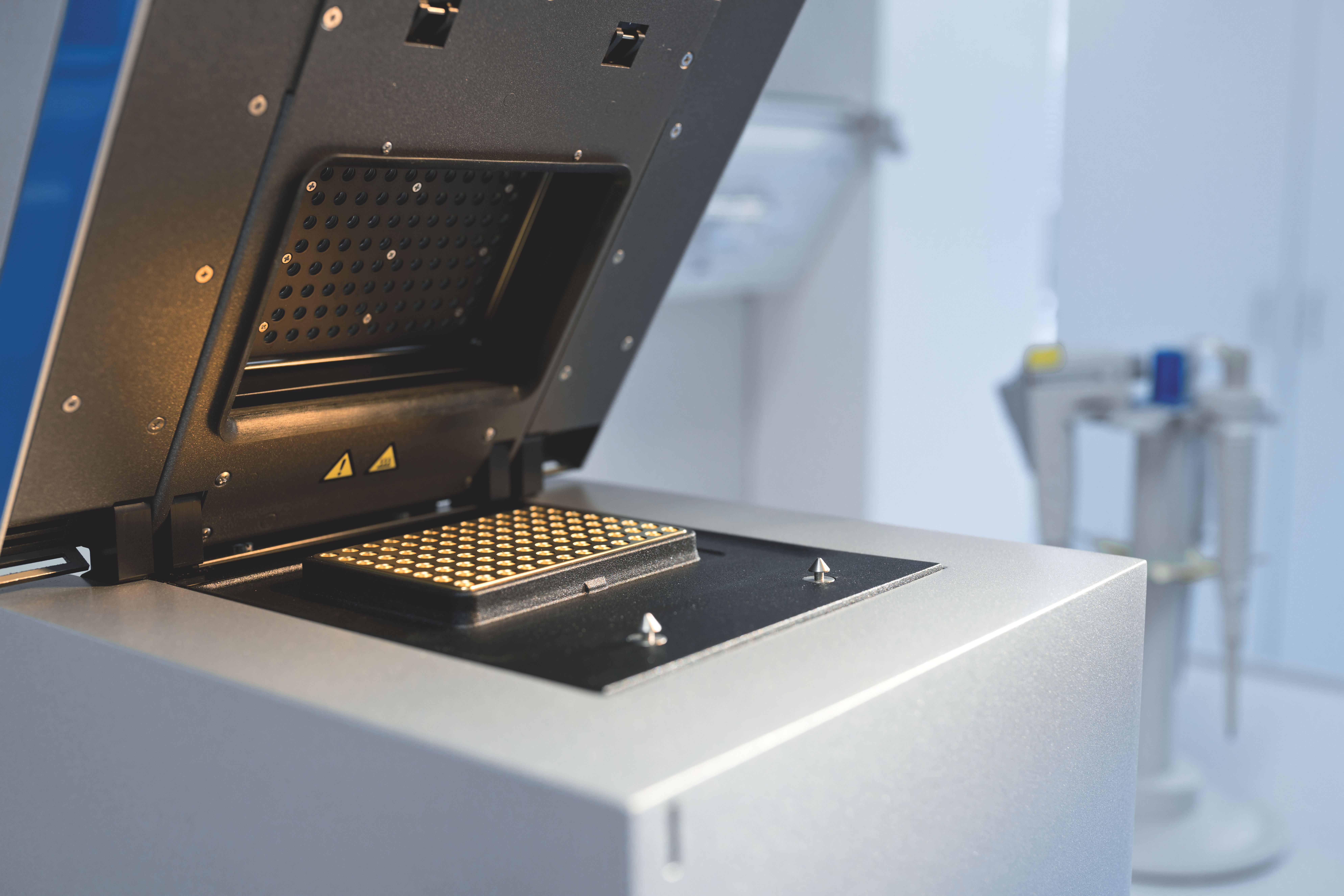
QIAcuity Digital PCR System

用于基于纳米板的数字 PCR 应用

Virtual Demo(虚拟演示)
探索虚拟之旅,了解更多信息并查看该产品的实用效果。

QIAcuity One, 2plex Device

目录编号 / ID.   911001

可检测最多 2 种荧光染料的单板数字 PCR 仪、封板滚轮、USB 闪存和 QIAcuity Software Suite:包括 1 次预防性保养访问。还包括为期一年的人工、差旅和部件担保。
格式
One
Four
Eight
多通道检测
2 channels (up to 4plex)
8 channels (up to 12plex)
服务选项
Device
System
System FUL-2
QIAcuity 旨在用于分子生物学应用。该产品不能用于疾病诊断、预防和治疗。因此,该产品在临床使用(即诊断、预后、治疗或血库学)中的性能特点尚属未知。 有关数字 PCR 的诊断应用,请使用 QIAcuityDx Digital PCR System
Virtual Demo(虚拟演示)
探索虚拟之旅,了解更多信息并查看该产品的实用效果。

特点

  • 全集成系统
  • 可扩展格式(单板、四板和八板仪器)
  • 高级多重检测功能(最多 12 路)
  • 最多六个标准通道加上两个用于 LSS 染料的杂合体通道
  • 灵活的样本通量
  • 大约 2 小时可获得综合性结果

产品详情

QIAcuity Digital PCR System 旨在于突变检测、拷贝数变异 (CNV)、基因表达研究、基因编辑分析及很多其他应用中交付精确且多重的定量结果。该基于纳米板的系统将一个包含分散化、热循环和成像的标准 dPCR 工作流无缝集成到一个手动操作时间极少的无人值守平台。

该系统与 QIAcuity 纳米板、试剂及检测结合使用。

探索该虚拟演示,进一步了解 QIAcuity。

绩效

QIAcuity Digital PCR System 让所有实验室都能用得上并负担得起绝对定量。无人值守自动化以极少的手动操作时间将包括分散化、热循环和成像在内的整个数字 PCR 工作流集成并精简到一个单一仪器上。您还可以方便地将您当前的 qPCR 检测转移到 QIAcuity Digital PCR System。从 qPCR 转过来时无需更改孔板处理,从而可确保快速构建检测并在约 2 小时内快速获得结果。

QIAcuity 仪器 – 功能和规格

特点 QIAcuity One 2plex QIAcuity One 5plex QIAcuity Four QIAcuity Eight
可处理的孔板数 1 1 4 8
检测通道(多重) 2

81)
(6+2 hybrid2)

81)
(6+2 hybrid2)
81)
(6+2 hybrid2)
多重检测功能  4 123)1) 123)1) 123)1)
热循环仪数目 1 1 1 2
从样本到结果的时间 大约 2 小时

大约 2 小时

首个孔板大约 2 小时

后续孔板每个孔板 ∼80 分钟

首个孔板大约 2 小时

后续孔板每个孔板 ∼40 分钟

通量(可在一个工作日内处理的样本数)

最多 384(96 孔)

最多 96(24 孔)

最多 384(96 孔)

最多 96(24 孔)

最多 672(96 孔)

最多 168(24 孔)

最多 1248(96 孔)

最多 312(24 孔)

1) 如果多路复用 >5 路复用,则需要使用 QIAcuity 高多路复用探针 PCR 试剂盒
2) 混合通道用于长斯托克斯位移 (LSS) 染料
3) 利用幅度多重检测技术,在六个标准通道中实现 12 个目标的并行检测。将用于单路 LSS 染料的杂合体通道与幅度多重检测技术相结合时,可能的多重检测总数可以增加到 14。然而,由于反应混合液中使用的所有检测均有优化需求,以及其相应的交叉干扰补偿,因此不建议采用这种组合。 


原理

仅需 3 个简单的步骤——移液及加载、运行实验和分析结果,您就能在大约 2 小时内获得 dPCR 结果。

有关纳米微孔板中 dPCR 反应的原理说明,请参见此处

程序

与 qPCR 实验一样,样本制备包括将预混液、探针和引物转移到一个 96 孔或 24 孔纳米微孔板中,随后添加样本。该系统将微分化、热循环和成像集成到单一全自动化的仪器上,使用户可在 2 小时内获得结果。您可在软件套组上执行分析,该软件可针对您的靶序列及质量控制(例如阳性样本或无模板对照)给出以每微升拷贝数表示的浓度。该分析还可在同一局域网 (LAN) 上的远程计算机上执行。

应用

QIAcuity 仪器与 QIAcuity 纳米板和 QIAcuity PCR 试剂盒的联合使用可让您执行各种数字 PCR 应用,包括:

  • 罕见突变检测
  • 拷贝数变异分析
  • 基因表达分析
  • 病原体检测
  • 基因分型
  • miRNA 研究
  • 细胞和基因治疗


软件

与仪器一起提供并安装在单独的计算机上的 QIAcuity Software Suite 可控制一台或多台 QIAcuity 仪器,可直接连接到仪器或通过局域网 (LAN) 连接到仪器。使用 QIAcuity Software Suite,您定义数字 PCR 实验、样本和反应混合物,将其分配至孔板并转移到 QIAcuity 仪器。运行完成后,您可分析数据,生成报告,并可导出数据以供进行外部分析。该软件提供有多个模板功能,您可轻松访问重复使用的孔板布局及孔板运行参数,从而进一步改善您的数字 PCR 体验。

在集成到一个局域网中时,该计算机将作为主机来托管 QIAcuity Software Suite 的功能,该计算机可供其他作为客户端的计算机通过 LAN 访问。这使得多个用户可通过标准浏览器从其他房间或办公室访问该软件并分析数据,而无需在多台计算机上安装该软件或通过互联网连接访问并交换数据。

服务

使用来自 QIAGEN 的各种解决方案为您的仪器提供保护。根据您的需求,进一步了解某个具体服务协议

辅助数据和图表

Kits & Consumables

dPCR Kits
dPCR Assays
dPCR Accessories
QIAcuity High Multiplex Probe PCR Kit (5mL) image
Cat. No.: 250134
€1,475.00
QIAcuity RCL Quant Kit image
Cat. No.: 250322
€2,136.00
QIAcuity Probe PCR Kit (1 ml) image
Cat. No.: 250101
€226.00
QIAcuity Probe PCR Kit (25 ml) image
Cat. No.: 250103
€4,484.00
QIAcuity UCP Probe PCR Kit (1 ml) image
Cat. No.: 250121
€248.00
QIAcuity UCP Probe PCR Kit (5 ml) image
Cat. No.: 250122
€1,167.00

服务计划

QIAcuity One 2plex Full Agreement

目录编号 / ID.   9245362

QIAcuity One 2plex 现场仪器维修,包括为期一年的差旅、人工和部件。响应时间为两个工作日。包括在完整协议期内进行一次预防性保养。

QIAcuity One 2plex Core Agreement

目录编号 / ID.   9245358

一次现场检修服务和一次现场预防性保养服务,包括为期一年的差旅、人工和部件。响应时间为五个工作日。包括协议期内额外检修服务享受 10% 折扣。

QIAcuity One 5plex Core Agreement

目录编号 / ID.   9245359

一次现场检修服务和一次现场预防性保养服务,包括为期一年的差旅、人工和部件。响应时间为五个工作日。包括协议期内额外检修服务享受 10% 折扣。

QIAcuity Four Core Agreement

目录编号 / ID.   9245360

一次现场检修服务和一次现场预防性保养服务,包括为期一年的差旅、人工和部件。响应时间为五个工作日。包括协议期内额外检修服务享受 10% 折扣。

QIAcuity Eight Core Agreement

目录编号 / ID.   9245361

一次现场检修服务和一次现场预防性保养服务,包括为期一年的差旅、人工和部件。响应时间为五个工作日。包括协议期内额外检修服务享受 10% 折扣。

QIAcuity One 2plex Basic Agreement

目录编号 / ID.   9245401

QIAcuity One 2plex 现场仪器维修,包括为期一年的差旅、人工和部件。响应时间为五个工作日。包括在基本协议期内进行一次预防性保养或检查服务。

QIAcuity One 5plex Basic Agreement

目录编号 / ID.   9245402

QIAcuity One 5plex 现场仪器维修,包括为期一年的差旅、人工和部件。响应时间为五个工作日。包括在基本协议期内进行一次预防性保养或检查服务。

QIAcuity One 5plex Full Agreement

目录编号 / ID.   9245363

QIAcuity One 5plex 现场仪器维修,包括为期一年的差旅、人工和部件。响应时间为两个工作日。包括在完整协议期内进行一次预防性保养。

QIAcuity Four Full Agreement

目录编号 / ID.   9245364

QIAcuity Four 现场仪器维修,包括为期一年的差旅、人工和部件。响应时间为两个工作日。包括在完整协议期内进行一次预防性保养。

QIAcuity Eight Full Agreement

目录编号 / ID.   9245365

QIAcuity Eight 现场仪器维修,包括为期一年的差旅、人工和部件。响应时间为两个工作日。包括在完整协议期内进行一次预防性保养。

常见问答

Is it possible to change voltage set-up from 110V to 230V on the QIAcuity instruments?

This is not needed. The QIAcuity is equipped with a flexible power supply technology and operates within a range of 100–240V AC, 50/60 Hz, 1500 VA (max). 

FAQ-3761
Can I see error codes on the instrument touchscreen?

The instrument software GUI shows error codes including a description and information how to resolve the error. The instrument touchscreen shows an alarm icon in the upper right corner that turns red in case of an instrument failure. Accessing the System Status in the Tool tab allows users to clear errors. Rebooting of the instrument is required to complete the removal of the error.  Please do not skip this step. You may always contact QIAGEN Technical Services in case of any question. 

FAQ-3763
What is the scope of a regular maintenance of the QIAcuity?

The user manual contains instructions on how to perform a regular cleaning and decontamination, and how to replace air filters on the QIAcuity instruments. A regular maintenance reduces the dust in the instrument and therefore minimizes the presence of dust particles on the nanoplate, which might interfere with the plate analysis.

FAQ-3765
What is the impact of not applying the latest VPF? Can I reanalyze previously obtained results after installing the latest VPF?

If you had run a nanoplate for which the installed VPF misses the specific factor, the software will notify you. If you then analyze without the specific VPF, the impact depends on the variation of the partition volume of the new Nanoplate batch compared to the latest. Typically this variation is ±6–7% (approx. 5% CV over the entire plate). The analysis may be repeated after updating the VPF file. After installing the latest VPF and re-analysis of the run, a copy of the plate is generated in the QIAcuity Software Suite including the new results. 

FAQ-3769
Can I see on the QIAcuity Software Suite report file if the VPF (Volume Precision Factor) has been used or not?

Yes, the report includes a notification if the matching VPF was missing and, therefore, not applied to the analysis. If the matching VPF was applied there is no notification on the report. 

FAQ-3770
Is it necessary to reanalyze a plate with VPF (Volume Precision Factor) that was already processed using a QIAcuity instrument that was purchased in 2020?

If you had analyzed your nanoplates without VFP, the impact depends on the variation of the partition volume of the new nanoplate batch compared to the latest. The VPF reduces the CV from approximately 5% to 2%. We recommend to reanalyze results in case the data originated from different wells (e.g., copy number variations or gene expression data sets for which the reference sample was measured in a different well). Results obtained across different plates should also be r-analyzed. A reanalysis is not required for assay data that were analyzed within the same well (e.g., mutation rate determination using two channels within the same well).

FAQ-3771
Can I prepare a dPCR reaction directly in QIAcuity Nanoplate?

A standard PCR plate is required to set up dPCR reaction before transferring it to the nanoplate to ensure a proper mixing of the reaction mix before partitioning. 

FAQ-3774
Can I use a custom master mix instead of a QIAGEN master mix?

QIAGEN master mixes are optimized for nanoplate microfluidics and are recommended to be used with our dPCR system. They also include an optimized reference dye required for proper analysis.

FAQ-3777
How to prepare DNA prior to dPCR?

All DNA samples used in reaction mixes should show similar quality and quantity, which can easily be assessed using UV spectrophotometry. DNA samples with an average length of ≥20 kb (e.g., genomic DNA purified via spin column with silica membrane) should be fragmented by restriction digestion before partitioning. Enzymatic fragmentation of larger DNA ensures an even distribution of template throughout the QIAcuity Nanoplate, which in turn leads to an accurate and precise quantification.

FAQ-3778
What are the storage conditions and expiry date of QIAcuity consumables?

The QIAcuity Probe PCR Kit should be stored immediately upon receipt at –30 to –15°C in a constant-temperature freezer and protected from light. The QIAcuity Probe PCR master mix can also be stored protected from light at 2–8°C. Components are stable for 12 months, unless otherwise indicated on the label. 
The QIAcuity EG PCR Kit should be stored immediately upon receipt at –30 to –15°C in a constant-temperature freezer and protected from light. The QIAcuity EG PCR master mix can also be stored protected from light at 2–8°C. Components are stable for 6 months, unless otherwise indicated on the label. 
The QIAcuity Nanoplates does not have expiry date and are stable for at least 1 year when stored at RT. 

FAQ-3780
Can I use the QIAcuity Nanoplate in more than one runs?

The plate is designed for a single use run. For example, even if only 30 samples are loaded into the 96-well plate, a whole plate will be sealed by the roller. It can't be unsealed and used for another run. The QIAcuity Software won’t allow to set up a separate experiment for the same nanoplate to avoid that previously processed plates being not partitioned a second time.

FAQ-3781
Can I optimize a dPCR assay on the QIAcuity using gradient temperature?

An essential temperature gradient functionality was introduced with software version 2.5. When updating older software versions to 2.5, each QIAcuity instrument will offer the temperature gradient and may be used to find the best cycling temperature for new dPCR assays. When running a QIAcuity Four or a QIAcuity Eight, all plates may have their own temperature profile, including the option for a temperature gradient.

FAQ-3783
What is the VPF (Volume Precision Factor)?

The VPF provides a set of well-specific and molding form-specific factors used to specify the exact reaction volume of a nanoplate, thus increasing the concentration calculation of each well. 

FAQ-3784
When and how often do I need a new VPF (Volume Precision Factor)?

 In general, nanoplates provide partitions of fixed sizes that enable a very precise way of sample concentration calculation. If a new molding form is used for nanoplate manufacturing, potential variation of partition sizes can be addressed by applying the molding form-specific VPF. Thus, each time a new molding form is used, a new VPF is created and made available. Currently, the VPF is updated once every 3–6 months.

FAQ-3785
Is a standard curve needed in dPCR?

In dPCR we measure the absolute concentration of targets at endpoint reaction. Concentrations of unknowns can be determined based on dPCR results observed (number of negatives, number of positives, and partition volume analyzed).

FAQ-3786