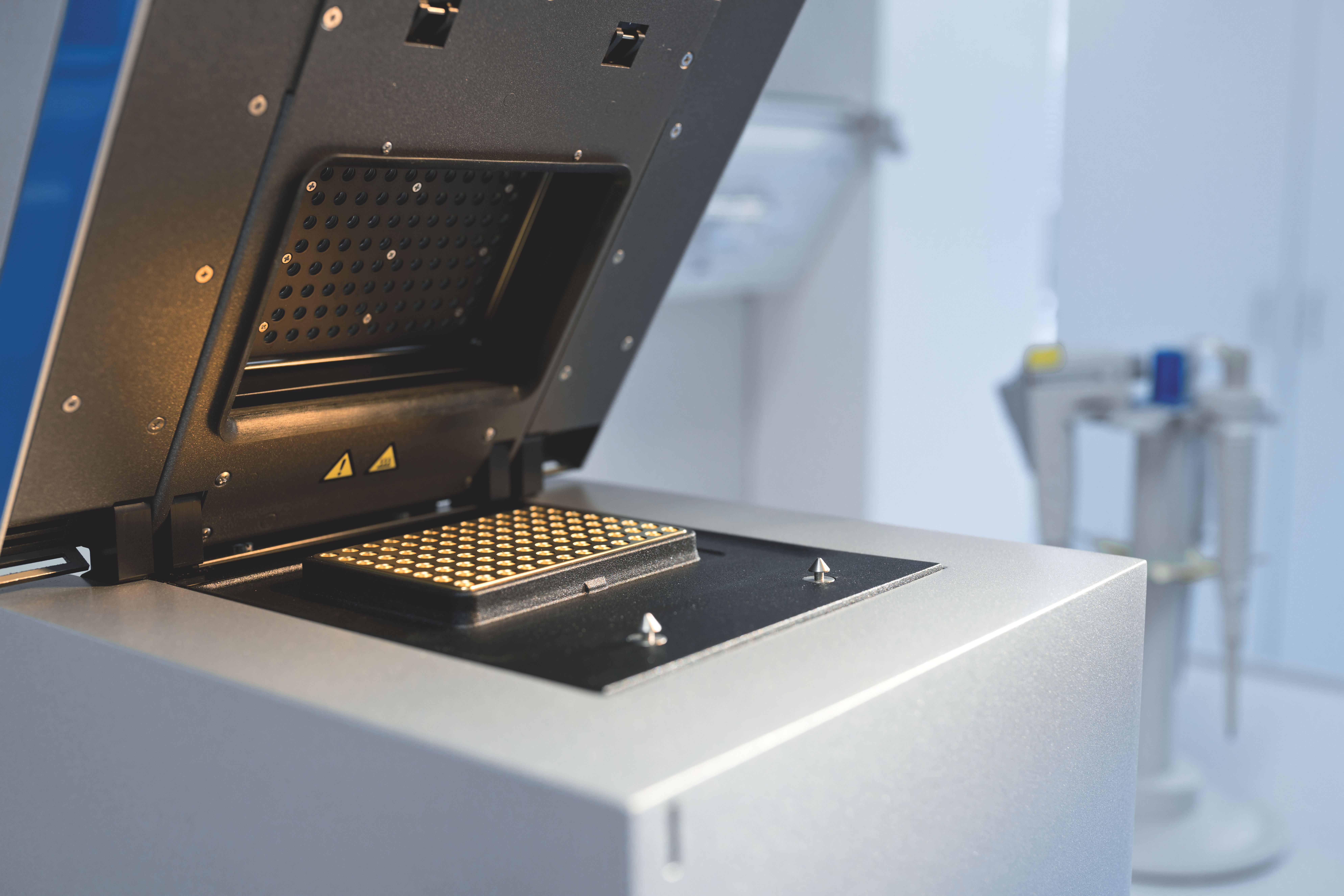
QIAcuityデジタルPCRシステム

ナノプレートを使用するデジタルPCRアプリケーション向け

バーチャルデモ
バーチャルツアーに参加し、この製品が実際に作動している様子をご覧ください。

QIAcuity One, 2plex Device

カタログ番号 / ID.   911001

最大2色の蛍光色素を検出する1プレートタイプのデジタルPCR装置、ローラー、USBフラッシュメモリー、およびQIAcuity Software Suite。予防保守点検訪問1回分を含みます。人件費、交通費、部品費について1年間保証。
フォーマット
One
Four
Eight
マルチチャンネル検出
2 channels (up to 4plex)
8 channels (up to 12plex)
サービスオプション
Device
System
System FUL-2
QIAcuityは、分子生物学アプリケーション向けに設計されています。本製品を疾病の診断、予防、治療に使用することはできません。そのため、臨床用途(診断、予後、治療、または血液バンク)としてご使用できません。 デジタルPCRの診断アプリケーションについては、QIAcuityDx Digital PCR Systemをご利用ください。
バーチャルデモ
バーチャルツアーに参加し、この製品が実際に作動している様子をご覧ください。

特徴

  • 完全統合型のシステム
  • スケーラブルなフォーマット(装置プレート1枚、4枚、8枚)
  • 高度なマルチプレックス能力(最大12プレックス)
  • LSS染料用の最大6つの標準チャンネルと2つのハイブリッドチャンネル
  • 柔軟性に富んだサンプルスループット
  • わずか2時間ですべての結果を提供

製品詳細

QIAcuityデジタルPCRシステムは、突然変異検出、コピー数多型(Copy Number Variation, CNV)、遺伝子発現研究、遺伝子編集解析、その他多くの用途で正確なマルチプレックス定量を行えるように設計されています。ナノプレートを使用する本システムは、パーティショニング、ヒートサイクル、およびイメージングの標準的なデジタル PCRワークフローを最小限の労力で実施できる、シームレスに統合された完全自動化プラットフォームです。

本システムは、QIAcuityナノプレート、試薬、アッセイと組み合わせて使用します。

QIAcuityについての詳しい情報は、バーチャルデモをご覧ください。

パフォーマンス

QIAcuityデジタルPCRシステムは、すべての研究室に絶対定量をお手頃な価格で提供します。パーティショニング、ヒートサイクル、イメージングの全デジタルPCRワークフローを1つの装置に統合し、最小限の労力で実施できる自動化装置です。また、現行のリアルタイム PCRアッセイをQIAcuity デジタルPCR システムに適用することも簡単です。リアルタイムPCR からデジタル PCRで解析を行う場合、プレート操作を変える必要はなく、簡便なアッセイのセットアップと約2時間での迅速な解析を行うことができます。

QIAcuity装置:機能と仕様

特徴 QIAcuity One 2plex QIAcuity One 5plex  QIAcuity Four QIAcuity Eight
プレート処理数 1 1 4 8
検出チャンネル 2 81
(6+2 hybrid2
81
(6+2 hybrid2
81
(6+2 hybrid2
マルチプレックス能力  4 123)1)  123)1)  123)1) 
サーモサイクラー 1 1 1 2
結果までの時間 約2時間 約2時間h

最初のプレートは約2時間

80分ごとに次のプレート

最初のプレートは約2時間

40分ごとに次のプレート

スループット(1日のサンプル処理数)

最大384(96ウェル)

最大96(24ウェル)

最大384(96ウェル)

最大96(24ウェル)

最大672(96ウェル)

最大168(24ウェル)

最大1,248(96ウェル)

最大312(24ウェル)

1) 5 プレックスを超えるマルチプレックスの場合は、QIAcuity High Multiplex Probe PCR Kitを使用する必要があります
2) ロングストークスシフト (LSS) 色素にはハイブリッド チャネルが使用されます
3)6つの標準チャンネルで増幅マルチプレックスを使用することで、12個のターゲットを並行して検出できます。シングルプレックスLSS染料用ののハイブリッドチャンネルと増幅マルチプレックスを組み合わせると、可能なマルチプレックスの合計を14に増やすことができます。ただし、反応混合物で使用されるすべてのアッセイの最適化とそれに対応するクロストーク補正が求められるため、この組み合わせは推奨されません。


原理

分注およびロード、実験、結果解析というわずか3つのステップで、約2時間でdPCRの結果が得られます。

ナノプレートでのdPCR反応の原理はこちらで説明しています。

操作手順

リアルタイム PCR実験と同様に、サンプル調製では、マスターミックス、プローブ、プライマーを96または24ウェルナノプレートに加え、その後サンプルを加えます。このシステムは、パーティショニング、ヒートサイクル、イメージングを1つに統合した完全自動化装置です。サンプルから結果まで2時間未満で完了します。専用ソフトウェア Software Suiteは、ターゲット配列のマイクロリットルあたりのコピー数(濃度)を示すことに加え、陽性サンプルやNTCなどの品質コントロールも解析できます。この解析は、同じローカルエリアネットワーク(LAN)内の離れた場所にあるコンピューターでも行うことができます。

アプリケーション

QIAcuity装置は、QIAcuity NanoplatesおよびQIAcuity PCR Kitと組み合わせて、次のデジタルPCRアプリケーションに利用できます。

  • 希少突然変異の検出
  • コピー数多型解析
  • 遺伝子発現解析
  • 病原体検出
  • ジェノタイピング
  • miRNA研究
  • 細胞および遺伝子治療


ソフトウェア

QIAcuity Software Suiteは装置に同梱されており、個々のコンピューターにインストールできます。これは、装置に直接接続、または既存のローカルエリアネットワーク(LAN)を使用して、1台または複数のQIAcuity装置を制御します。QIAcuity Software Suiteを用いて、デジタルPCR 実験、サンプル、反応ミックス情報を入力し、ナノプレートに割り当て、QIAcuity装置に転送できます。測定終了後は、データ解析とレポート作成が可能になります。解析のため、データを外部へエクスポートすることができます。本ソフトウェアには、繰り返し使えるプレートレイアウトや簡単にアクセスできるプレートランパラメーターの設定などのテンプレート機能があり、デジタルPCR実験をさらに使いやすく、より身近な解析方法となり得ます。

ローカルエリアネットワークに組み込むことで、QIAcuity コンピューターはクライアントとして機能する他のコンピューターにLAN経由でアクセスできるサーバーとなります。このようにして QIAcuity Software Suiteと通信できるようになります。これにより、複数のユーザーが他の部屋やオフィスからソフトウェアにアクセスしたり、複数のコンピューターにソフトウェアをインストールしなくても標準的なブラウザを介してデータを解析したり、インターネット接続を経由してデータのやり取りができるようになります。

サービス

QIAGENの多様なサービスソリューションなら機器を安心してご利用いただけます。ニーズに合ったサービス契約の詳細をご覧ください。

裏付けデータと数値

Kits & Consumables

dPCR Kits
dPCR Assays
dPCR Accessories
QIAcuity RCL Quant Kit image
Cat. No.: 250322

サービスプラン

QIAcuity One 2plex Full Agreement

カタログ番号 / ID.   9245362

QIAcuity One  2Plex の派遣費、技術料および交換部品代を含む1年間の修理費用をカバー。契約期間内に1回の定期点検が付帯。対応時間2日以内

QIAcuity One 2plex Core Agreement

カタログ番号 / ID.   9245358

年1回の出張修理と予防保守点検訪問に対応します。交通費、人件費、補修部品費が含まれています。受付から5営業日以内に対応します。契約期間における追加の出張修理費については10%減額します。

QIAcuity One 5plex Core Agreement

カタログ番号 / ID.   9245359

年1回の出張修理と予防保守点検訪問に対応します。交通費、人件費、補修部品費が含まれています。受付から5営業日以内に対応します。契約期間における追加の出張修理費については10%減額します。

QIAcuity Four Core Agreement

カタログ番号 / ID.   9245360

年1回の出張修理と予防保守点検訪問に対応します。交通費、人件費、補修部品費が含まれています。受付から5営業日以内に対応します。契約期間における追加の出張修理費については10%減額します。

QIAcuity Eight Core Agreement

カタログ番号 / ID.   9245361

年1回の出張修理と予防保守点検訪問に対応します。交通費、人件費、補修部品費が含まれています。受付から5営業日以内に対応します。契約期間における追加の出張修理費については10%減額します。

QIAcuity One 5plex Full Agreement

カタログ番号 / ID.   9245363

QIAcuity One  5Plex の派遣費、技術料および交換部品代を含む1年間の修理費用をカバー。契約期間内に1回の定期点検が付帯。対応時間2日以内

QIAcuity Four Full Agreement

カタログ番号 / ID.   9245364

QIAcuity Four の派遣費、技術料および交換部品代を含む1年間の修理費用をカバー。契約期間内に1回の定期点検が付帯。対応時間2日以内

QIAcuity Eight Full Agreement

カタログ番号 / ID.   9245365

QIAcuity Eight の派遣費、技術料および交換部品代を含む1年間の修理費用をカバー。契約期間内に1回の定期点検が付帯。対応時間2日以内

よくある質問

Is it possible to change voltage set-up from 110V to 230V on the QIAcuity instruments?

This is not needed. The QIAcuity is equipped with a flexible power supply technology and operates within a range of 100–240V AC, 50/60 Hz, 1500 VA (max). 

FAQ-3761
Can I see error codes on the instrument touchscreen?

The instrument software GUI shows error codes including a description and information how to resolve the error. The instrument touchscreen shows an alarm icon in the upper right corner that turns red in case of an instrument failure. Accessing the System Status in the Tool tab allows users to clear errors. Rebooting of the instrument is required to complete the removal of the error.  Please do not skip this step. You may always contact QIAGEN Technical Services in case of any question. 

FAQ-3763
What is the scope of a regular maintenance of the QIAcuity?

The user manual contains instructions on how to perform a regular cleaning and decontamination, and how to replace air filters on the QIAcuity instruments. A regular maintenance reduces the dust in the instrument and therefore minimizes the presence of dust particles on the nanoplate, which might interfere with the plate analysis.

FAQ-3765
What is the impact of not applying the latest VPF? Can I reanalyze previously obtained results after installing the latest VPF?

If you had run a nanoplate for which the installed VPF misses the specific factor, the software will notify you. If you then analyze without the specific VPF, the impact depends on the variation of the partition volume of the new Nanoplate batch compared to the latest. Typically this variation is ±6–7% (approx. 5% CV over the entire plate). The analysis may be repeated after updating the VPF file. After installing the latest VPF and re-analysis of the run, a copy of the plate is generated in the QIAcuity Software Suite including the new results. 

FAQ-3769
Can I see on the QIAcuity Software Suite report file if the VPF (Volume Precision Factor) has been used or not?

Yes, the report includes a notification if the matching VPF was missing and, therefore, not applied to the analysis. If the matching VPF was applied there is no notification on the report. 

FAQ-3770
Is it necessary to reanalyze a plate with VPF (Volume Precision Factor) that was already processed using a QIAcuity instrument that was purchased in 2020?

If you had analyzed your nanoplates without VFP, the impact depends on the variation of the partition volume of the new nanoplate batch compared to the latest. The VPF reduces the CV from approximately 5% to 2%. We recommend to reanalyze results in case the data originated from different wells (e.g., copy number variations or gene expression data sets for which the reference sample was measured in a different well). Results obtained across different plates should also be r-analyzed. A reanalysis is not required for assay data that were analyzed within the same well (e.g., mutation rate determination using two channels within the same well).

FAQ-3771
Can I prepare a dPCR reaction directly in QIAcuity Nanoplate?

A standard PCR plate is required to set up dPCR reaction before transferring it to the nanoplate to ensure a proper mixing of the reaction mix before partitioning. 

FAQ-3774
Can I use a custom master mix instead of a QIAGEN master mix?

QIAGEN master mixes are optimized for nanoplate microfluidics and are recommended to be used with our dPCR system. They also include an optimized reference dye required for proper analysis.

FAQ-3777
How to prepare DNA prior to dPCR?

All DNA samples used in reaction mixes should show similar quality and quantity, which can easily be assessed using UV spectrophotometry. DNA samples with an average length of ≥20 kb (e.g., genomic DNA purified via spin column with silica membrane) should be fragmented by restriction digestion before partitioning. Enzymatic fragmentation of larger DNA ensures an even distribution of template throughout the QIAcuity Nanoplate, which in turn leads to an accurate and precise quantification.

FAQ-3778
What are the storage conditions and expiry date of QIAcuity consumables?

The QIAcuity Probe PCR Kit should be stored immediately upon receipt at –30 to –15°C in a constant-temperature freezer and protected from light. The QIAcuity Probe PCR master mix can also be stored protected from light at 2–8°C. Components are stable for 12 months, unless otherwise indicated on the label. 
The QIAcuity EG PCR Kit should be stored immediately upon receipt at –30 to –15°C in a constant-temperature freezer and protected from light. The QIAcuity EG PCR master mix can also be stored protected from light at 2–8°C. Components are stable for 6 months, unless otherwise indicated on the label. 
The QIAcuity Nanoplates does not have expiry date and are stable for at least 1 year when stored at RT. 

FAQ-3780
Can I use the QIAcuity Nanoplate in more than one runs?

The plate is designed for a single use run. For example, even if only 30 samples are loaded into the 96-well plate, a whole plate will be sealed by the roller. It can't be unsealed and used for another run. The QIAcuity Software won’t allow to set up a separate experiment for the same nanoplate to avoid that previously processed plates being not partitioned a second time.

FAQ-3781
Can I optimize a dPCR assay on the QIAcuity using gradient temperature?

An essential temperature gradient functionality was introduced with software version 2.5. When updating older software versions to 2.5, each QIAcuity instrument will offer the temperature gradient and may be used to find the best cycling temperature for new dPCR assays. When running a QIAcuity Four or a QIAcuity Eight, all plates may have their own temperature profile, including the option for a temperature gradient.

FAQ-3783
What is the VPF (Volume Precision Factor)?

The VPF provides a set of well-specific and molding form-specific factors used to specify the exact reaction volume of a nanoplate, thus increasing the concentration calculation of each well. 

FAQ-3784
When and how often do I need a new VPF (Volume Precision Factor)?

 In general, nanoplates provide partitions of fixed sizes that enable a very precise way of sample concentration calculation. If a new molding form is used for nanoplate manufacturing, potential variation of partition sizes can be addressed by applying the molding form-specific VPF. Thus, each time a new molding form is used, a new VPF is created and made available. Currently, the VPF is updated once every 3–6 months.

FAQ-3785
Is a standard curve needed in dPCR?

In dPCR we measure the absolute concentration of targets at endpoint reaction. Concentrations of unknowns can be determined based on dPCR results observed (number of negatives, number of positives, and partition volume analyzed).

FAQ-3786